A government-authorised, university-recognised short-term programme providing a foundational understanding of human rights law — from constitutional protections and NHRC mechanisms to international treaties and UN frameworks.
The Certificate Course in Human Rights at ISBR Law College, Bengaluru is a government-authorised, university-recognised short-term programme designed to provide participants with a comprehensive understanding of human rights law at both the national and international level. As societies grow increasingly aware of dignity, equality, and justice, professionals with expertise in human rights law are invaluable across government, civil society, international organisations, and the legal profession.
The programme covers the philosophical foundations of human rights, the Indian constitutional framework for rights protection, the role of the National Human Rights Commission (NHRC) and State Human Rights Commissions, international covenants, UN treaty bodies and mechanisms, and the special protections available to vulnerable groups including women, children, minorities, persons with disabilities, LGBTQ+ individuals, and refugees.
Students engage with real case studies, landmark judgments, and simulation exercises — developing the analytical and advocacy skills needed to work effectively in this vital field.
Who Can Apply?
Pass in Higher Secondary (10+2) Examination or equivalent from any recognised Board or Council in any discipline.
Graduates, legal practitioners, civil services aspirants, NGO workers, journalists, policy researchers, and social workers are particularly well-suited for this programme.
Working professionals in government, administration, education, international organisations, or civil society seeking a structured grounding in human rights law are encouraged to apply.
Our Purpose
Programme Objectives
01
To equip participants with a comprehensive understanding of the historical foundations, philosophical principles, and universal standards of human rights as enshrined in the UDHR and international covenants.
02
To analyse the constitutional and statutory framework for the protection of human rights in India, including the role, jurisdiction, and powers of the National Human Rights Commission and State mechanisms.
03
To expose students to international human rights instruments, UN treaty bodies, Special Rapporteurs, and India's obligations under international human rights law — and how these interact with domestic law.
04
To develop practical skills in human rights documentation, advocacy, Public Interest Litigation drafting, and fact-finding — preparing students for field, court, and international organisation work.
How We Teach
Course Features & Learning Methodology
Key Features
Global perspective with focus on both domestic and international human rights frameworks, including connections to courts, commissions, UN bodies, and civil society organisations.
Regular updating of content to reflect the latest NHRC directives, Supreme Court judgments, UN recommendations, and emerging rights issues — delivered by accomplished full-time faculty.
Rigorous, relevant, contemporary, and progressive curriculum aligned with the demands of civil services, legal practice, NGO work, and international organisations.
Continuous evaluation using the formative assessment system for the calculation of Grade Point Averages (GPA).
Learning Methodology
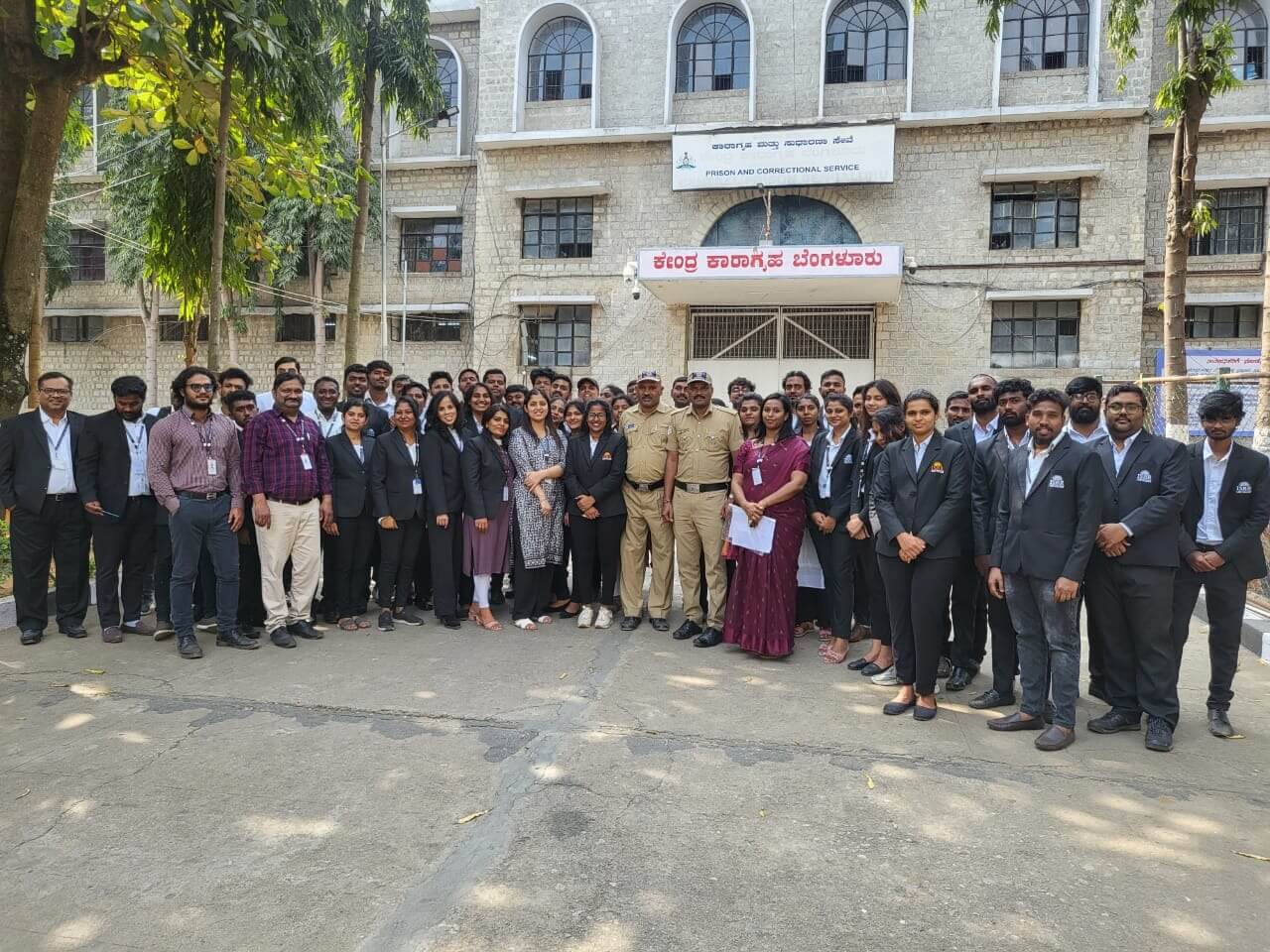
Interactive Lectures Case Study Analysis Classroom Projects & Seminars Moot Courts & PIL Drafting Group Presentations Field Projects & NHRC Visits Expert & Guest Lecturers Human Rights Documentation Labs
Recognitions
Affiliations & Approvals
KSLU Affiliated
Affiliated to Karnataka State Law University (KSLU), Hubballi — a premier statutory law university of Karnataka.
BCI Approved
Approved by the Bar Council of India — the statutory body regulating legal education and the legal profession in India.
What You'll Learn
Programme Highlights
Universal Declaration of Human Rights (UDHR) 1948
Constitutional Framework for Rights in India
National Human Rights Commission & SHRCs
International Human Rights Law & UN Treaties
Women's Rights (CEDAW) & Children's Rights (UNCRC)
Rights of Persons with Disabilities (UNCRPD)
Rights of Minorities, Refugees & Indigenous Peoples
LGBTQ+, Environmental & Technology Rights
PIL Drafting & Legal Advocacy Skills
Human Rights Documentation & Fact-Finding
Academic Structure
Programme Structure
The single semester covers the complete landscape of human rights law — from philosophical origins and constitutional protections to international mechanisms and practical advocacy skills.
Paper Code
Subject
Credits
Internal Assessment
University Examinations
Total Marks
1.1
Foundations and Philosophy of Human Rights
4
30
70
100
1.2
Constitutional Framework for Human Rights in India
4
30
70
100
1.3
National Human Rights Commission and State Mechanisms
4
30
70
100
1.4
International Human Rights Law and UN Mechanisms
4
30
70
100
1.5
Rights of Vulnerable Groups – Women, Children, Minorities & Refugees
4
30
70
100
1.6
Emerging Human Rights Issues – LGBTQ+, Disability, Environment & Technology
4
30
70
100
1.7
Human Rights Advocacy, Documentation & PIL Drafting Skills
2
30
70
100
Total
26
210
490
700
After the Course
Career & Opportunity Pathways
A certificate in Human Rights Law opens doors across legal advocacy, civil society, international organisations, civil services, policy research, and journalism — wherever protecting dignity and holding power accountable creates value.
Human Rights Lawyer
Pursue PIL, constitutional remedies, and human rights litigation before High Courts and the Supreme Court.
NGO & Civil Society
Lead legal teams, document rights violations, and advocate for vulnerable communities at home and abroad.
UN & International Organisations
Work with UNHCR, UNICEF, UN Women, and international human rights bodies on field and policy roles.
Civil Services (IAS / IPS)
Build a strong foundation in human rights for UPSC, state PSC, and international organisation recruitment.
Policy Research & Advocacy
Work with think tanks, government ministries, and law reform commissions on rights-based policy drafting.
Legal Journalism & Media
Report accurately on rights violations, court judgments, and human rights policy with legal literacy.
Transparent fee structure with scholarship opportunities for deserving and meritorious students.
Fee Component
Amount (Day Scholar)
Payment Schedule
Registration Fee (One-time, non-refundable)
₹10,000
At time of admission
Programme Tuition Fee (6 Months)
₹25,000
Before commencement of programme
Total Programme Fee
₹35,000
Single payment
Hostel and accommodation charges are additional (see Hostel Fees tab). Examination fees as per KSLU norms will be charged separately. For detailed fee breakdowns, download the Fee Structure below.
Hostel fee is for one academic year or till 30 June, 2026, whichever is earlier, and should not be mistaken for a calendar year.
Particulars
Breakfast Only Plan
All Meals Plan
Refundable Hostel Security Deposit(One Time)
₹20,000
₹20,000
Double Occupancy Breakfast Only Plan: Twin sharing accommodation, breakfast, transport and basic amenities. All Meals Plan: Twin sharing accommodation, breakfast, lunch, dinner, transport and basic amenities.
₹1,50,000
₹2,02,000
Single Occupancy Breakfast Only Plan: Single room accommodation, breakfast, transport and basic amenities. All Meals Plan: Single room accommodation, breakfast, lunch, dinner, transport and basic amenities.
₹2,75,000
₹3,27,000
Important Notes
Hostel rooms are allotted on first come first serve basis.
Hostel room can be reserved by paying the refundable security deposit.
Hostel fees includes food and accommodation and basic amenities as provided in the hostel.
Hostel rooms are available on twin sharing basis with attached bathroom facility.
Single occupancy rooms are subject to availability and on first come first serve basis.
Hostel rooms are furnished with Cupboard, Bed, Mattress, Study table, Chair and TV.
Vegetarian meals served – Breakfast, Lunch & Dinner.
GST is levied as per the prevailing government norms.
Fees can be paid via Demand Draft, Net Banking / RTGS / NEFT, or Debit / Credit card.
Bank Account Details
Bank Name: Union Bank of India
Account Name
ISBR
Account No.
51034 10006 68920
Branch
Electronic City
Account Type
Current
IFSC Code
UBIN 090 8371
Branch Code
08372
Scholarship & Financial Aid
ISBR offers a variety of scholarships for meritorious and deserving candidates. Scholarships are offered to students in the form of tuition fee waivers.
Scholarship Category
Academic Criterion (X & XII Performance)
UGAT Score
CLAT Score
LSAT-India Score
ISBR Aptitude Test
Scholarship Offered
Recipients
MERIT
9 CGPA & above or equivalent
85 percentile & above
Score of 120 & above
80 percentile & above
85 percentile and above
50% waiver in tuition fee
9
8 CGPA & above or equivalent
75 percentile & above
Score range between 110 to 119
70 percentile & above
75 percentile & above
25% waiver in tuition fee
15
SPORTS (National Level Participation in Class XI / XII)
7 CGPA & above or equivalent
70 percentile & above
Score range between 100 to 109
65 percentile & above
70 percentile & above
20% waiver in tuition fee
6
Scholarships are applicable on the programme tuition fee only and are non-transferable. Merit is evaluated at the time of admission based on the criteria above.
Hear from our Certificate in Human Rights graduates on how this course deepened their understanding and shaped their careers.
"
This course transformed my understanding of human rights from an abstract concept into a practical legal tool. I work at an NGO supporting trafficking survivors, and what I learned here — about NHRC complaints, PIL drafting, and international mechanisms — has directly helped our legal team pursue justice for our clients.
RA
Riya Agarwal
Certificate – Human Rights, Batch 2023
"
I enrolled as a fresh graduate unsure of my path. The Certificate in Human Rights made me realise this is exactly where I want to build a career. The international modules were particularly eye-opening — I had no idea about the depth of the UN treaty system until this course. I am now pursuing a master's in international law.
KU
Khushi Umja
Certificate – Human Rights, Batch 2022
"
Preparing for the UPSC, I found most resources covering rights superficially. This programme goes much deeper — you don't just study provisions, you understand the judgments, the advocacy, and the gaps. My essay and GS II answers have become qualitatively different. Six months that completely shifted my perspective.
GA
Garima Anand
Certificate – Human Rights, Batch 2024
"
I work in corporate ESG and sustainability, where human rights due diligence has become a regulatory requirement under multiple international frameworks. This course gave me both the legal vocabulary and the substantive knowledge to lead our company's human rights impact assessments. It has made me significantly more effective in translating international standards into corporate practice.
AP
Arjun Pillai
Certificate – Human Rights, Batch 2023
"
After completing this programme, I applied for and secured a position with an international NGO working on refugee rights in South Asia. The coverage of UN mechanisms — UPR, treaty bodies, Special Rapporteurs — was exactly the preparation I needed. ISBR's faculty brought these abstract processes to life through real case studies and field simulations.
SK
Sunita Krishna
Certificate – Human Rights, Batch 2022
"
I run a legal aid clinic in a rural district of Karnataka, and human rights law is at the heart of every case we handle. Before this programme, I lacked the confidence to argue fundamental rights violations in higher courts. After completing this course, I have successfully filed three PIL petitions on behalf of marginalised communities. This programme genuinely changes lives.
RS
Rohit Saxena
Certificate – Human Rights, Batch 2024
Meet Your Mentors
Faculty Speak
Our faculty bring decades of expertise in human rights law, combining scholarly depth with practical advocacy and policy experience.
RN
Dr. R. Narasimhan
Dean, ISBR Law College
ISBR Law College, Bengaluru
"Human rights law is where the universal meets the particular — where international norms must be made real for individual citizens. Understanding this interface is what transforms a practitioner into a true advocate for human dignity and justice."
AK
Prof. Amit Kachabhana
Director, Centre for Advancement
Associate Professor, ISBR Law College
"From the UDHR to the latest NHRC directives, human rights law demands both legal precision and moral clarity. We teach students to hold both with equal rigour — because this work demands no less than the full force of knowledge and conscience."
AA
Dr. Anand Agarwal
Public Law & Human Rights
Professor, ISBR Law College
"Whether you intend to work with the courts, the UN, an NGO, or the government — a strong foundation in human rights law gives you the frameworks to protect the most vulnerable and hold power accountable in every arena."
Resources
Downloads
Access all important documents related to the Certificate Course in Human Rights here.
Our admissions team is available to guide you through the enrolment process, answer your queries on eligibility, fees, and scholarships, and help you take the first step towards building a career in human rights law.
ISBR Law College, 16, 2nd Main Rd, Electronic City Phase I, Electronic City, Konappana Agrahara, Karnataka – 560100.
Champion Dignity. Defend Rights. Change Lives.
Enrol in the Certificate Course in Human Rights at ISBR Law College and build a career protecting what matters most — human dignity, equality, and justice.